






Bundesliga Final Day: Relegation Drama & European Race Settled

There is a particular kind of cruelty to a final day in football. Every team kicks off simultaneously, every scoreline is live and unknowable, and somewhere in the stands there are people who have no idea yet whether their Saturday afternoon will end in tears or something approaching joy. Matchday 34 of the 2025-26 Bundesliga delivered all of that, and then some.
Check here for Comprehensive match results for Bundesliga 2025 – 26 Season.
By the time the dust had settled on a breathless afternoon of German football, Stuttgart had secured the final Champions League qualification spot, Wolfsburg had snatched a relegation play-off lifeline, and both St. Pauli and Heidenheim had been sent down to the second division. Three storylines, all resolved within the same ninety minutes, all pulling at each other with the kind of dramatic tension that makes the sport genuinely difficult to look away from.
Start at the top, because that is where the season-long intrigue had been building most intensely. Heading into the afternoon, VfB Stuttgart, Hoffenheim and Bayer Leverkusen were all battling for the final Champions League berth, with Stuttgart and Hoffenheim level on 61 points but separated by goal difference, and Leverkusen three points back on 58. The maths was messy, the nerves presumably worse.
Stuttgart were the team in the most enviable position, and they played like it for large portions of the afternoon at Deutsche Bank Park. They went two goals up against Eintracht Frankfurt in the first half, doing their job, holding their nerve, controlling a match that demanded control. Then Jonathan Burkardt intervened. The Frankfurt striker scored two late penalties to level the match at 2-2, and for a few agonising minutes the permutations spiralled. Could Hoffenheim capitalise? Could Leverkusen?They could not. Hoffenheim were beaten 4-0 at Borussia Mönchengladbach, and Leverkusen could only manage a 1-1 draw at home to Hamburger SV. Stuttgart’s draw, nerve-shredding as it was, proved enough. For Stuttgart, there is still one more highlight ahead: the DFB-Pokal final next Saturday against Bayern Munich in Berlin. The Swabians go into it with something extra to celebrate.
Then there was the matter of the bottom of the table, where the afternoon produced scenes of a different emotional register entirely. Three clubs Wolfsburg, Heidenheim and St. Pauli were not just level on points but barely separated on goal difference went into the final matches knowing two of them would be relegated. The fixture list had conjured something almost theatrical: Wolfsburg travelling to St. Pauli, two of the three protagonists facing each other directly at the Millerntor, while Heidenheim hosted Mainz across town in a game that would need to go a very specific way to offer any hope.
Wolfsburg won the relegation decider 3-1 at St. Pauli to send the home side down and qualify for a play-off against the third-placed team from the second division. The Wolves were clinical when they had to be, decisive when the moment demanded it. They had won just once in their previous sixteen league games, which makes that result all the more remarkable as a feat of concentration under pressure.
At the Voith-Arena, the news for Heidenheim was bleaker still. They had needed a win against Mainz to keep their hopes alive, and they lost 2-0. Mainz made things clear early on with two goals in the first half, leaving Heidenheim to spend the second half watching their fate be decided elsewhere. Frank Schmidt’s side had been extraordinary over the previous few weeks, staging a remarkable late-season recovery, but it was not quite enough. Heidenheim, who promoted to the Bundesliga in 2023 and have competed with distinction since, had trailed the play-off spot by ten points as recently as Matchday 26 before engineering an unlikely comeback that ultimately fell one result short.
The scenes at St. Pauli were something else. Head coach Alexander Schmidt spoke of the solidarity among the supporters — flags being waved in the stands even as relegation was confirmed — and described it as something rare and worth treasuring in football. The Millerntor has always been one of German football’s more unusual places, and Saturday afternoon felt like a fitting, if painful, summation of what this club represents.Elsewhere, the afternoon offered some more straightforward narratives.
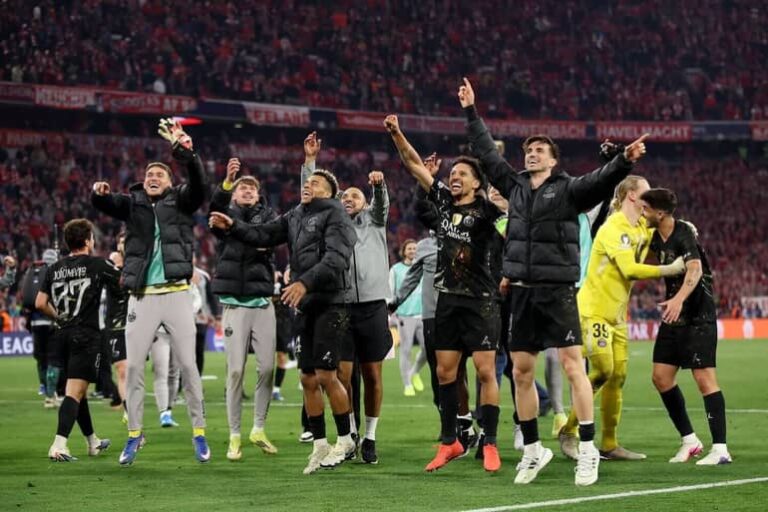
Harry Kane scored a hat-trick to take his season tally to 36 Bundesliga goals as Bayern Munich beat Cologne 5-1 and were handed the league trophy after the final whistle. Bayern captain Manuel Neuer, who extended his contract the previous day, gave the trophy to Leon Goretzka to hoist skyward — Goretzka’s last Bundesliga appearance for the club. It was the kind of send-off that turns a routine home victory into something more ceremonial.
Freiburg beat RB Leipzig 4-1 to secure a Conference League play-off spot, and they will have very little time to enjoy it: they face Aston Villa in the Europa League final in Istanbul on Wednesday. Freiburg, the perpetually overachieving club from the Black Forest, somehow finds itself in an European final and fighting for continental qualification through the league at the same time. There are quieter weeks in football.
Marie-Louise Eta, who became the first female coach in Bundesliga history when she took charge of Union Berlin, oversaw a 4-0 win over Augsburg in her final match of the season. Union finished with a draw and two wins across her five games at the helm before her scheduled move to lead their women’s team though the question of whether those results earn her a longer stay with the men’s side will presumably now be asked rather more loudly.
The play-off drama is not finished either. Second-division champions Schalke will return to the Bundesliga next season, while Elversberg, Hannover and Paderborn are level on points heading into Sunday’s second division final day, with the third-place finisher still to be determined — and with it, Wolfsburg’s play-off opponent. One more round of matches. One more afternoon to decide who gets another chance.
German football has a habit of doing this. Of constructing final days that feel like the game at its most elemental where the points mean everything, where the mathematics refuse to simplify, and where the human cost of the result is written plainly on the faces in the stands. Saturday delivered on every count, and for two clubs, the season ended in the harshest possible way. For one, it ended with a draw that felt like a win. And for Bayern, it ended with beer showers and a trophy and Harry Kane still improving on numbers that already defy belief.