






Crystal Palace Stun Shakhtar Donetsk 3-1 in Conference League Semi-Final First Leg

Crystal Palace took a commanding first-leg advantage in their UEFA Conference League semi-final, producing a disciplined, devastating away performance in Krakow to leave Shakhtar Donetsk with an enormous mountain to climb before next week’s return at Selhurst Park.
The first leg was played at Henryk Reyman’s Municipal Stadium, with 26,000 Ukrainians creating a raucous atmosphere as Oliver Glasner warned his players to expect a baptism of fire. What nobody could have anticipated, however, was just how brutally and immediately Palace would silence that noise.
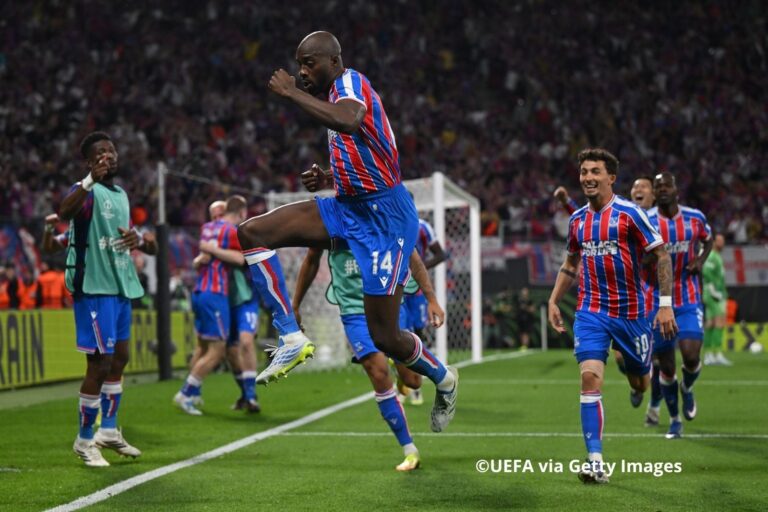
Crystal Palace took the lead and made UEFA Conference League history within 21 seconds in Krakow, Ismaila Sarr directing a cool finish across goal from Jean-Philippe Mateta’s set-up for the fastest goal in competition history. The previous mark was 32 seconds, set by Ferdy Druijf for SK Rapid. It was a goal of remarkable simplicity — a sharp knockdown, a clean connection, and the net rippling before most supporters had taken their seats. Sarr, cool and purposeful, swept into the far corner with a finish that belied the extraordinary pressure of the occasion.
Check out Comprehensive match Statistics here>>>>
Sarr has now scored in Palace’s last four Conference League matches, and his form at this level has been nothing short of spectacular. The Senegalese winger, so often the catalyst for everything positive about Palace in Europe, was a constant menace throughout the first half, stretching Shakhtar’s defensive lines and drawing fouls in dangerous areas. With Mateta alongside him providing the aerial threat and the hold-up play, Glasner’s attacking partnership was functioning precisely as designed.
Shakhtar, to their credit, did not shrink. Arda Turan’s side, playing only their third European defeat of an extraordinarily busy season in which they have played 19 UEFA games, gradually found their feet and began to ask questions through their rapid, technically gifted South American contingent. Kauã Elias led the line with energy and intelligence, while Pedrinho and Marlon Gomes probed and drifted between the lines. Palace, happy to absorb and soak up pressure, held firm to carry their slender but precious lead into the interval.
Glenn Hoddle noted from the studio that it was a brilliant night for Palace, who showed a great reaction to being pegged back later in the game — but the reaction required in the opening moments of the second half was equally telling. Within two minutes of the restart, Shakhtar were level. The visitors were undone from a careless set-piece just after the break, allowing Shakhtar to win first and second contact from a corner, finished from close range by Oleh Ocheretko. It was scrappy, opportunistic, and exactly the kind of goal that can swing the momentum of a two-legged tie irrevocably.
The atmosphere inside the ground surged. Pressure built as Arda Turan’s side pressed and dominated the ball. The tie looked to be turning. Shakhtar’s players sensed blood, flooding forward with increasing urgency, their technical quality now more prominent as Palace found themselves pinned back and rattled. For a period of perhaps fifteen minutes, the Palace backline — marshalled by Lacroix and Canvot — was under sustained siege.Yet Palace were happy to sit in their shape out of possession, retaining a constant threat on the counter. They missed a succession of chances before finally making one count — Sarr and Mateta drew a fantastic double save from Dmytro Riznyk, and the latter hit the post in a frantic, breathless passage of play that summed up Palace’s knife-edge existence in this match. They were one moment away from conceding the lead entirely, yet they always looked capable of wounding Shakhtar on the break.
At the 58th minute, Kamada converted after a long throw-in, restoring Palace’s advantage in thoroughly clinical fashion. It was a goal born from set-piece intelligence rather than open play — a long throw into the box, confusion in the Shakhtar defence, and Daichi Kamada arriving at exactly the right moment to finish with the composure of a man who had been saving himself for precisely this kind of opportunity.
Kamada was judged the best player on the pitch by pundits at full time, scoring the second and making the third for Strand Larsen, who came on as a second-half substitute. The Japanese midfielder’s influence on this match was enormous — constantly pressing, always available, linking the defensive and attacking phases in a way that gave Palace’s shape its fundamental coherence. When he was eventually withdrawn for Lerma in the closing stages, he received a standing ovation he thoroughly merited.
On 84 minutes, Kamada started the move again, driving forward to release Strand Larsen, who steadied himself to loft his finish over Riznyk to the delight of the travelling supporters. It was a finish of real quality — Strand Larsen taking a touch to set himself before lifting the ball with the outside of his boot and watching it curl perfectly into the net. The Norwegian, who had entered as a substitute replacing Mateta, admitted afterward it was a goal he badly needed.Strand Larsen told TNT Sports:
“Obviously I needed that. I was unlucky last game against Liverpool. Felt like the confidence had dropped a little bit but always kept on going — you know it’s tough with two good players fighting for one spot.”
The way the second half unfolded suited Palace perfectly — a stylistic masterclass from Glasner. They were physically too tough for Shakhtar to break down from open play and possessed too much pace on the counter not to make good on their threat eventually. With less than 30 per cent possession across the full 90 minutes, it was an away performance built entirely on structural discipline, defensive resilience, and the lethal exploitation of transitions.Joleon Lescott summarised it neatly: “Palace are used to having limited possession but making it count when they get forward. At the start of the second half, I didn’t see them winning the game, but once they got back in front, they never looked like losing it. Shakhtar, as they poured forward, were always susceptible to the counter-attack.” Oliver Glasner said: “I’m very happy with the performance. I could see how good Shakhtar are — so many quick players. The plan was to not give them space because when we get exposed it’s so difficult to defend them. Credit to the players, they stuck to the plan. When we were in attack we were very threatening, and I was very impressed with the reaction when we conceded the equaliser.”
Shakhtar coach Arda Turan acknowledged Palace’s quality: “The result is disappointing but there were moments in the game when I was pleased with my players. We had chances. Let’s not forget that we played against a great team with great players in attack and a great coach.”
The second leg takes place at Selhurst Park on Thursday 7 May, with the winners of the tie advancing to the final in Leipzig, Germany on Wednesday 27 May. Palace, chasing what would be a second major trophy under Glasner, now hold a commanding two-goal advantage. Shakhtar have shown they are far from finished, and will need to produce something exceptional in south London — but on this evidence, Crystal Palace look very much like a team with a date in Leipzig already written in their diary.